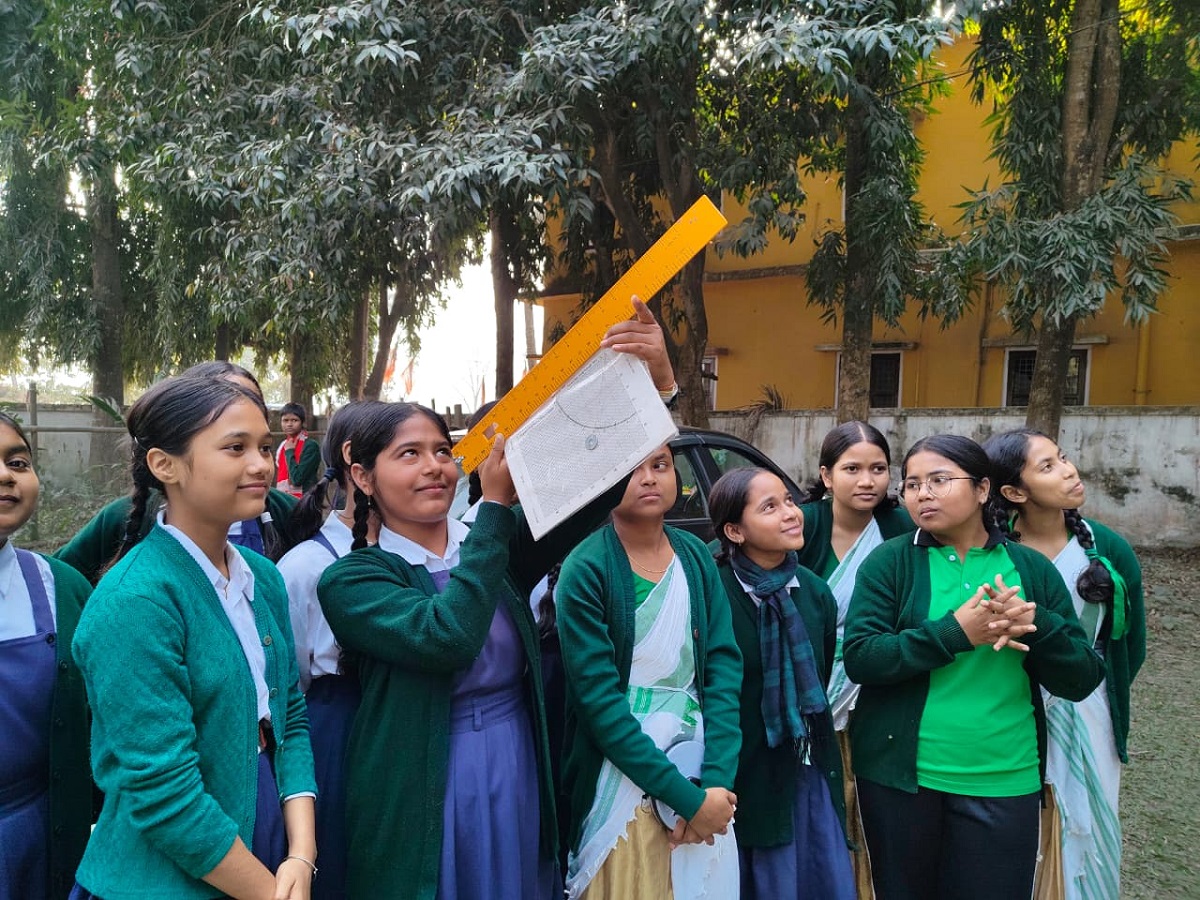
Aaranyak, a leading biodiversity conservation organisation of the region conducted a climate education outreach programme at two government schools in Kamrup (Metro) district of Assam, helping students understand the relations between climate change, trees, sustainability and mathematics.
The outreach event was organised on January 20 at Auniati Kamaldev Girls’ High School and North Guwahati Girls’ High School, with support from Wipro earthian. The initiative aimed to strengthen climate literacy among students through hands-on, experiential learning.
Climate change increasingly disrupts education by affecting student attendance, nutrition, safety and overall learning outcomes. Extreme events such as floods, cyclones, droughts and heatwaves frequently damage school infrastructure, disrupt academic calendars and displace families, placing children’s education at constant risk.
As India progresses towards its net-zero target by 2070, the Government of India has prioritised climate education through the National Education Policy (NEP) 2020 and the National Curriculum Framework (NCF) 2023, which emphasise sustainability, ecological understanding, green skills and experiential, skill-based learning.
In line with these national priorities, Aaranyak’s outreach programme engaged students in understanding climate change scientifically, recognising the ethical and ecological value of native trees, adopting sustainable practices and strengthening mathematical and analytical skills through real-life environmental applications.
“This is an interesting outdoor activity that helps students understand the ethical value of trees. It not only improves their mathematical skills but also enhances their understanding of ecosystems, climate change, and sustainability in an engaging way,” said Ms. Dulumani Rabha, Senior Science Teacher, North Guwahati Girls’ High School.
He explained that ancient Indian texts such as the Vedas regard trees as sacred entities linked
to the concept of Ṛta (ऋत)–the cosmic, moral and natural order of the universe and
emphasise tree protection as essential for sustaining this balance.
Students actively participated in practical exercises including plant height measurement, age
calculation and estimation of carbon storage, applying mathematical concepts to real-world
environmental contexts under expert guidance.
Forty-three students and teachers participated in the programme, which was coordinated by
Tikendrajit Gogoi.
“Our traditional wisdom reminds encourages protecting trees that are integral to maintaining
harmony with nature. Blending this ethical perspective with modern science strengthens
climate education among young learners,” said Jayanta Kumar Pathak, Assistant Director &
Head (In-charge), EECBD, Aaranyak.
Aaranyak conducts climate education outreach for students in Kamrup Metro