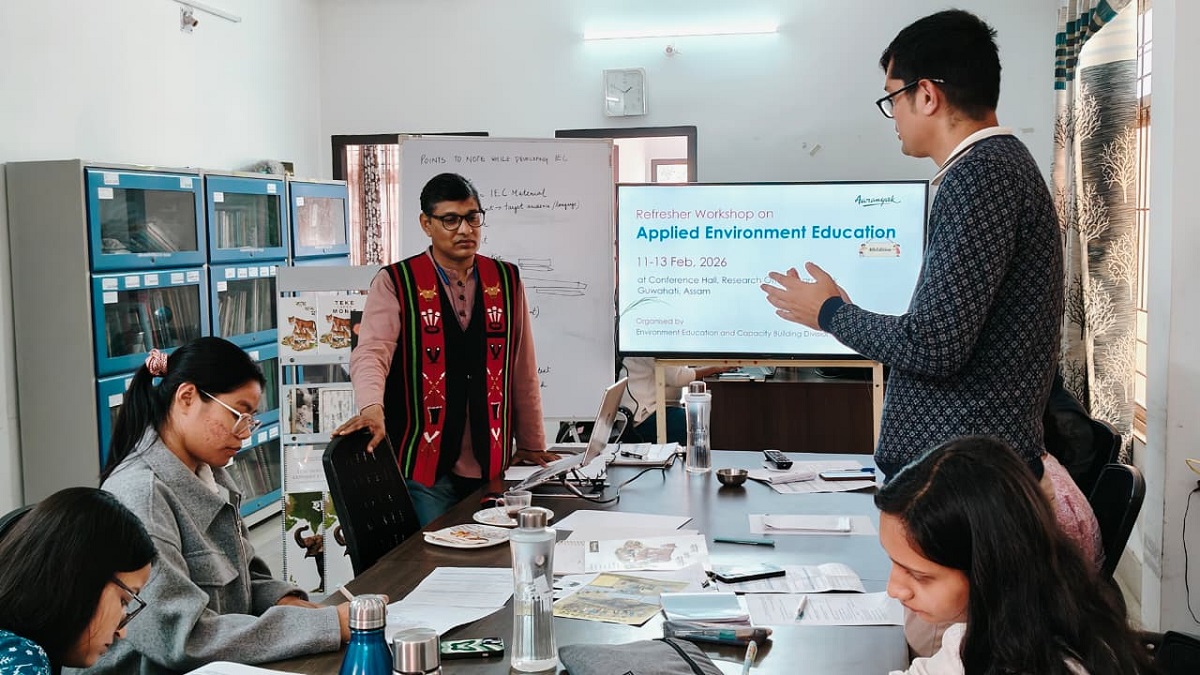
Aaranyak organized the 4th Refresher Workshop on Applied Environmental Education from February 11 to 13 in Guwahati through its Environment Education and Capacity Building Division (EECBD). The three-day workshop brought together educators and practitioners engaged in environmental education and conservation outreach to strengthen their understanding of applied environmental education approaches and practical conservation strategies.
The workshop aimed to equip participants with the skills to identify environmental challenges and design structured, practical interventions for diverse groups, including schools and local communities. The course was designed and led by Jayanta Kumar Pathak, Assistant Director and In-charge Head of EECBD, who focused on conservation strategies, environmental education frameworks, the Planning-Implementation-Evaluation (PIE) approach, and community engagement methods.
The programme also emphasised integrating environmental education into school systems and promoting experiential learning. Prajnyan Sarma presented a case study on classroom engagement for water conservation and introduced soil conservation activities. Tikendrajit Gogoi guided participants in developing environmental games and creative learning tools such as eco-printing and nature journaling.
On the final day, sessions focused on ethical communication and effective community engagement, highlighting the importance of cultural context, seasonal needs, and holistic approaches. Participants developed IEC materials and learned basic evaluation techniques to assess the impact of environmental education initiatives. Sharing her experience, Sanshumoi Basumatary from Kokrajhar said the workshop introduced new ideas that transformed her perspective on environmental education.
The workshop concluded with an interactive valedictory session encouraging participants to apply their learning in strengthening environmental education practices at institutional and community levels for the wellbeing of both people and nature.