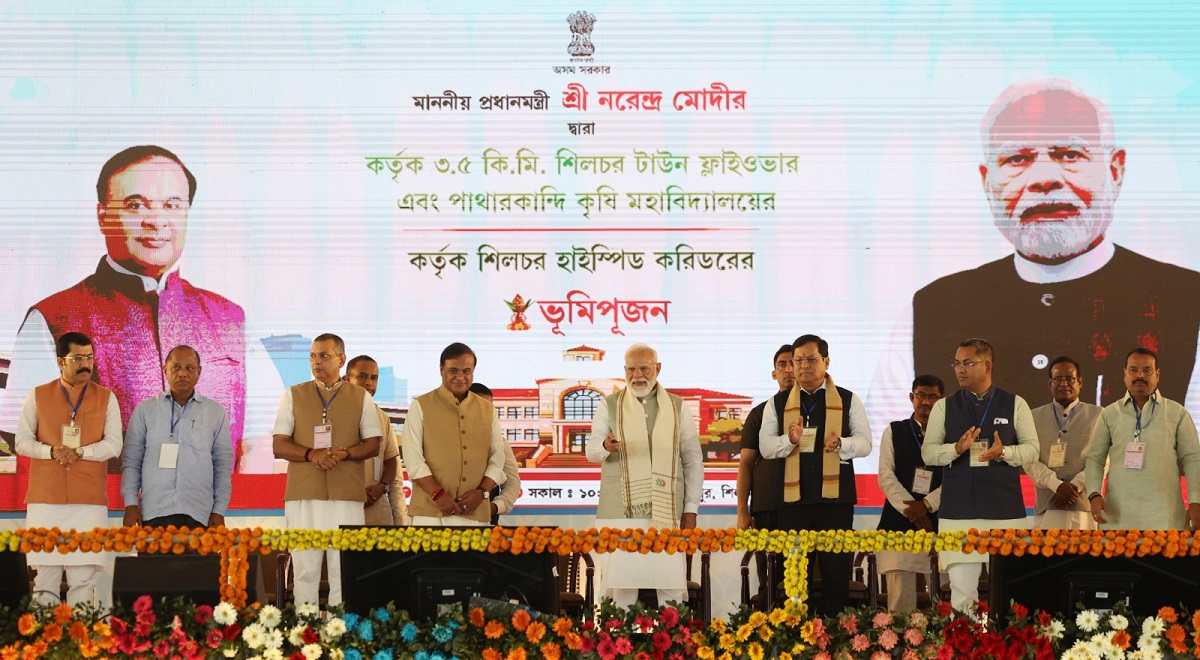
Prime Minister Narendra Modi on March 14 launched multiple development projects in Silchar in Assam and sharply criticised the Indian National Congress, claiming that the party is steadily losing public support across the country and may soon “hit a century of electoral defeats.”
Addressing a public gathering in the Barak Valley, Modi said that people in Assam had already rejected Congress and voters across the country were continuing to do the same.
“You have ousted the Congress from Assam. Today every state in the country is teaching the Congress a lesson. The Congress is losing election after election. In the near future, Congress is poised to hit a century of defeats,” the Prime Minister said.
He further accused Congress leaders of attempting to malign the country out of frustration over repeated electoral losses. Referring to a protest linked to an artificial intelligence summit, Modi alleged that Congress leaders staged an unusual demonstration.
“In a bid to discredit the AI summit, Congress staged a bizarre protest by tearing their own clothes in public. It appears the Congress has nothing left to do now but tear its own clothes in desperation,” he said.
Highlighting the development agenda of the Bharatiya Janata Party, Modi said the government’s priority is to uplift communities that have long remained behind in the development process.
“The BJP’s mantra is to prioritise those who are lagging behind in the race of development,” he said, adding that earlier governments considered border regions as the “last villages” of the country.
“We consider these border villages as the country’s first villages,” he said, noting that the next phase of the Vibrant Villages Programme aimed at developing border areas was launched from Cachar district in Assam.
The Prime Minister also highlighted welfare measures for tea garden communities, stating that the Government of Assam had taken a “historic step” by granting land rights to thousands of tea garden families.
Speaking about global developments, Modi said several parts of the world were witnessing war-like conditions and emphasised that the government is working to minimise the impact of global crises on Indian citizens.
“Nowadays conditions similar to war prevail in several parts of the world. Our government is making every effort to ensure that the citizens of our country face the fewest hardships possible,” he said.
He also accused Congress of attempting to create panic in the country during such challenging times and alleged that the party was failing to act responsibly in matters of national interest.
“The forces across the globe that are unable to digest India’s rapid development — the Congress is increasingly becoming a mere puppet in their hands,” Modi added.
Earlier in the day, the Prime Minister performed the Bhoomi Pujan for the Shillong–Silchar High-Speed Corridor, the first access-controlled Greenfield four-lane corridor in Northeast India.
The 166-kilometre corridor, to be built at an estimated cost of about ₹22,860 crore, will significantly improve connectivity between Meghalaya and Assam and reduce travel time between Guwahati and Silchar from around 8.5 hours to about five hours.
Modi alleged that Congress had neglected the development of the Barak Valley for decades after independence.
“The Congress had left the Northeast to its fate. When the country attained independence, the boundary was drawn in such a way that the Barak Valley’s vital link to the sea was completely severed,” he said.
Taking a swipe at Congress leaders, the Prime Minister remarked, “Just ask Congress leaders about this project. Give them a pen and paper and ask them to write ₹24,000 crore—they won’t even be able to do it.”
Meanwhile, Assam Chief Minister Himanta Biswa Sarma said the corridor project reflects India’s commitment to becoming a developed nation and expressed confidence that Assam would grow alongside the country’s progress.
“India is moving forward with the resolve to become a developed nation. As India progresses, our effort is that Assam also emerges as a strong and robust state,” Sarma said.
The project is expected to significantly strengthen regional connectivity, promote economic growth and improve trade links across the Northeast.