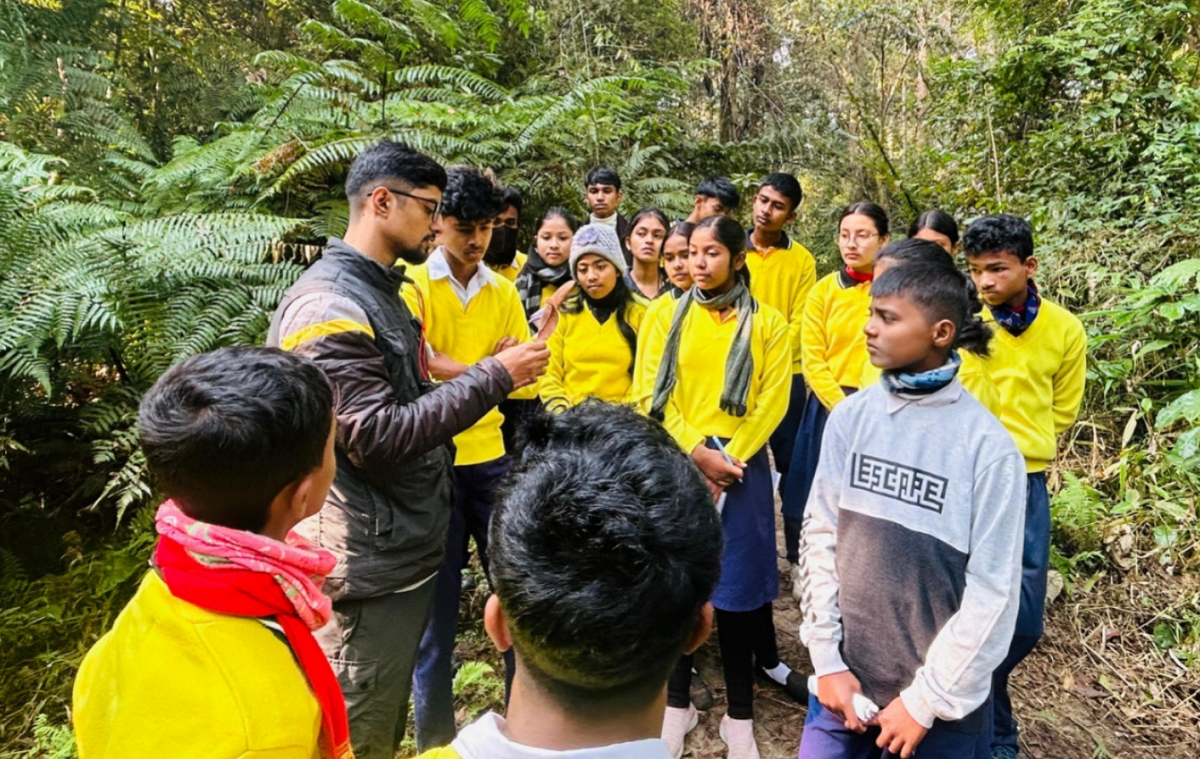
A group of students participated in an immersive nature trail at the
Hollongapar Gibbon Sanctuary in Assam’s Jorhat district, a crucial habitat for the threatened
hoolock gibbon.
The students were overwhelmed at the sight of a family of five hoolock gibbons – the only
ape species found in India along with capped langurs — a Malayan giant squirrel and a rich
variety of butterflies and spiders thriving in the forest ecosystem.
The nature trail was organised as part of ‘Nature’s Wonderland – A Journey of Curiosity”,
one of Aaranyak’s flagship environmental education initiatives and was successfully
conducted on January 16 last under the lush green canopy of the sanctuary.
The programme was jointly organised by leading biodiversity conservation organisation
Aaranyak’s Environment Education and Capacity Building Division (EECBD) and Primate
Research and Conservation Division (PRCD) in collaboration with the Jorhat Wildlife
Division of Assam Forest Department.
Hollongapar Gibbon Sanctuary, a vital remnant of Assam’s lowland rainforest is home to
seven primate species and plays a significant role in regional biodiversity conservation.
The programme aimed to ignite curiosity, enhance ecological understanding and foster
conservation ethics among young learners.
Students and teachers from Rongdoi High School, Jorhat participated actively in the
programme, gaining first-hand exposure to wildlife and forest ecosystems through
experiential learning. The nature trail was guided by Dhruba Chetia, Forest Staff, Mariani
Range and Akshay Kumar Upadhyaya, Research Fellow, Aaranyak.
Upadhyaya offered an insightful overview of Hoolock gibbons, explaining their food habits,
social structure and the distinctions between apes and other primates. He also highlighted the
importance of protected areas in maintaining ecological balance. He noted that Hoolock
gibbons are monogamous and live in small family units, unlike many other primates that live
in troops.
Assam Forest Department staff Chetia familiarised students with forest signs such as mud-
smeared elephant rubbing trees and elephant foot prints, which is construed indicative of
regular movement routes. He also helped identify native tree species and explained their
ecological importance in sustaining the forest landscape.
An interactive session was conducted by Tikendrajit Gogoi, Project Officer, EECBD,
Aaranyak, who emphasised that a healthy forest ecosystem is not defined solely by trees and
large mammals. He highlighted the role of smaller yet significant components such as
lichens, butterflies and insects as indicators of ecosystem health.
Sharing her experience, student participant Jusmi Das said, “Visiting Hollongapar Gibbon
Sanctuary was an amazing experience. We learned many new and interesting ideas about
ecosystems from the Aaranyak team. Seeing Assam’s state tree with our own eyes was truly
exciting. This visit will remain an inspiration for us.”
The event was supported by Wipro Earthian, YouthNet and Mobius Foundation, and actively
coordinated by Ashatora Sarma with assistance from Disha Haloi of EECBD, Aaranyak.
Nature’s Wonderland enlightens students on gibbons, forest life