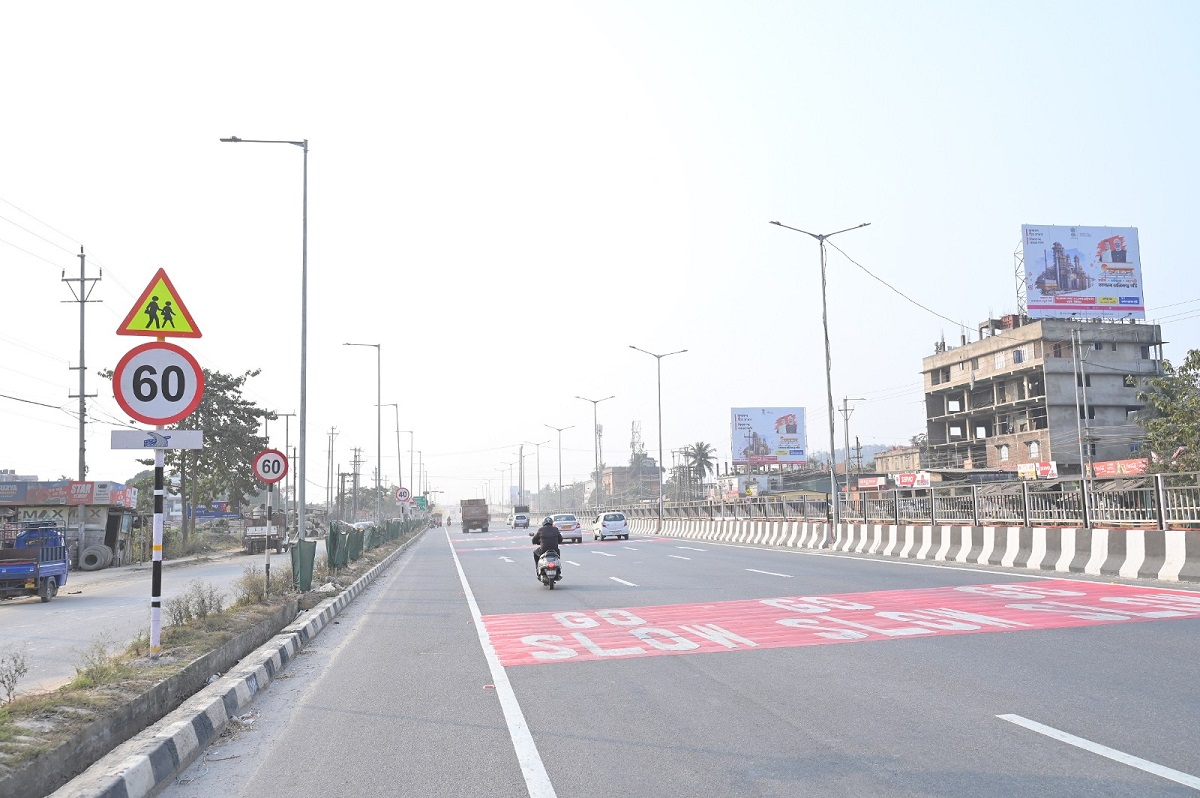
SaveLIFE Foundation (SLF), supported by the CSR initiative of Škoda Auto Volkswagen India Private Limited (SAVWIPL), has implemented a comprehensive school zone safety treatment at LP School, Paschim Boragaon, along the high-risk NH-27 corridor in Guwahati. As part of this intervention, SLF today conducted a multi-stakeholder school zone safety walkthrough to review the effectiveness of the measures and strengthen on-ground coordination.
The initiative was undertaken in collaboration with the Transport Department, Government of Assam, the Kamrup (Metropolitan) District Administration, and the National Highways Authority of India (NHAI).
The school zone safety treatment at LP School aims to address critical risks arising from heavy vehicular movement, unsafe pedestrian crossings, and unregulated boarding and alighting activity along the six-lane NH-27 corridor. Between 2023 and 2025, the location recorded six road crash fatalities, underscoring the vulnerability of children and local residents. Designed following rigorous crash data analysis, community engagement, and on-ground risk assessments, the intervention, formally approved in November 2025, focuses on correcting unsafe road design and movement patterns through targeted, evidence-based engineering measures. These include:
• Clearly defining the school zone through speed limit signage, “GO SLOW” markings, painted walking paths and blinkers.
• Providing designated pedestrian crossings supported by tactile bar markings and speed roundels to reduce approach speeds.
• Enhancing visibility through reflective signage.
• Creating safer, designated boarding and alighting zones using channelisation and coloured thermoplastic markings.
• Improving service road access management to separate pedestrian, local, and through traffic and reduce conflict with high-speed vehicles.
The treatment is designed to reduce crash risks for children, parents, and local residents while ensuring safer access to and from the school.
To review and refine the intervention, SLF organised a school zone safety walkthrough involving government stakeholders, enforcement agencies, corporate partners, school representatives, and members of the local community. The walkthrough enabled stakeholders to collectively assess the implemented measures, validate design assumptions against lived experiences, and identify opportunities for further strengthening safety outcomes.
Speaking about the intervention, Shri Gaurav Upadhyay, Additional Secretary, Transport Department, Government of Assam, said, “School zones are among the most sensitive road environments, and ensuring their safety requires coordinated, evidence-based action. Safety treatments such as those implemented here, when reviewed through on-ground walkthroughs, help us assess real risks faced by children and translate insights into practical engineering, enforcement, and awareness measures. The Transport Department remains committed to working closely with the NHAI, SaveLIFE Foundation and partner agencies to strengthen school zone safety across Assam.”
During the walkthrough, participants examined both existing and proposed safety elements forming part of the school zone treatment that take cognisance of pedestrian movement patterns, vehicle speeds, sightlines, and compliance behaviour. Structured, on-ground feedback was documented to guide further optimisation of the intervention and inform replication of effective school zone safety solutions across other high-risk locations in the district. In parallel, student engagement activities were conducted to build road safety awareness and encourage children to act as safety champions within their families and neighbourhoods.
Speaking about the initiative, Mr. Piyush Arora, MD & CEO at SAVWIPL, said, “Creating safer school zones requires evidence-based interventions that respond to how children and communities actually use the road. We are proud to support SaveLIFE Foundation in its endeavour to implement targeted safety measures such as traffic calming, improved signage, better pedestrian infrastructure, and visibility enhancements that reduce risk around schools. These interventions are critical to protecting children, moderating vehicle speeds, and making high-risk corridors safer for everyone.”
Sustained interventions remain critical in Kamrup (Metropolitan) district. As per the Integrated Road Accident Database (iRAD), 371 road crash fatalities were recorded between January and December 2024, while 356 fatalities were recorded during the same period in 2025, reflecting a 4.06% year-on-year reduction following the implementation of comprehensive safety interventions under the “Zero-Fatality District” programme in 2025. Notably, a previously treated school zone near NPS School in the district has recorded zero fatalities since SLF’s intervention in FY 2025, demonstrating the positive impact of targeted school zone safety treatments.
Speaking about the intervention, Mr. Piyush Tewari, Founder & CEO, SaveLIFE Foundation, said, “Children are among the most vulnerable road users, and unsafe school zones pose an unacceptable risk to their lives. Through our school zone safety treatments, supported by collaborative walkthroughs to review and strengthen them, we aim to address real-world risks and build shared ownership among all stakeholders. We are grateful to the Government of Assam, enforcement agencies, and our CSR partners for their continued support in advancing safer school zones.”
Under the Zero Fatality Districts (ZFD) Programme, SaveLIFE Foundation works with district administrations to eliminate preventable road crash fatalities through a data-driven, systems-based approach. The programme focuses on mitigating engineering risks, strengthening enforcement, improving post-crash emergency response, and building institutional and community capacity. Developed in collaboration with the Ministry of Road Transport and Highways, the ZFD Programme is being scaled nationally across the 100 most high-risk districts identified using a composite road crash severity index.